

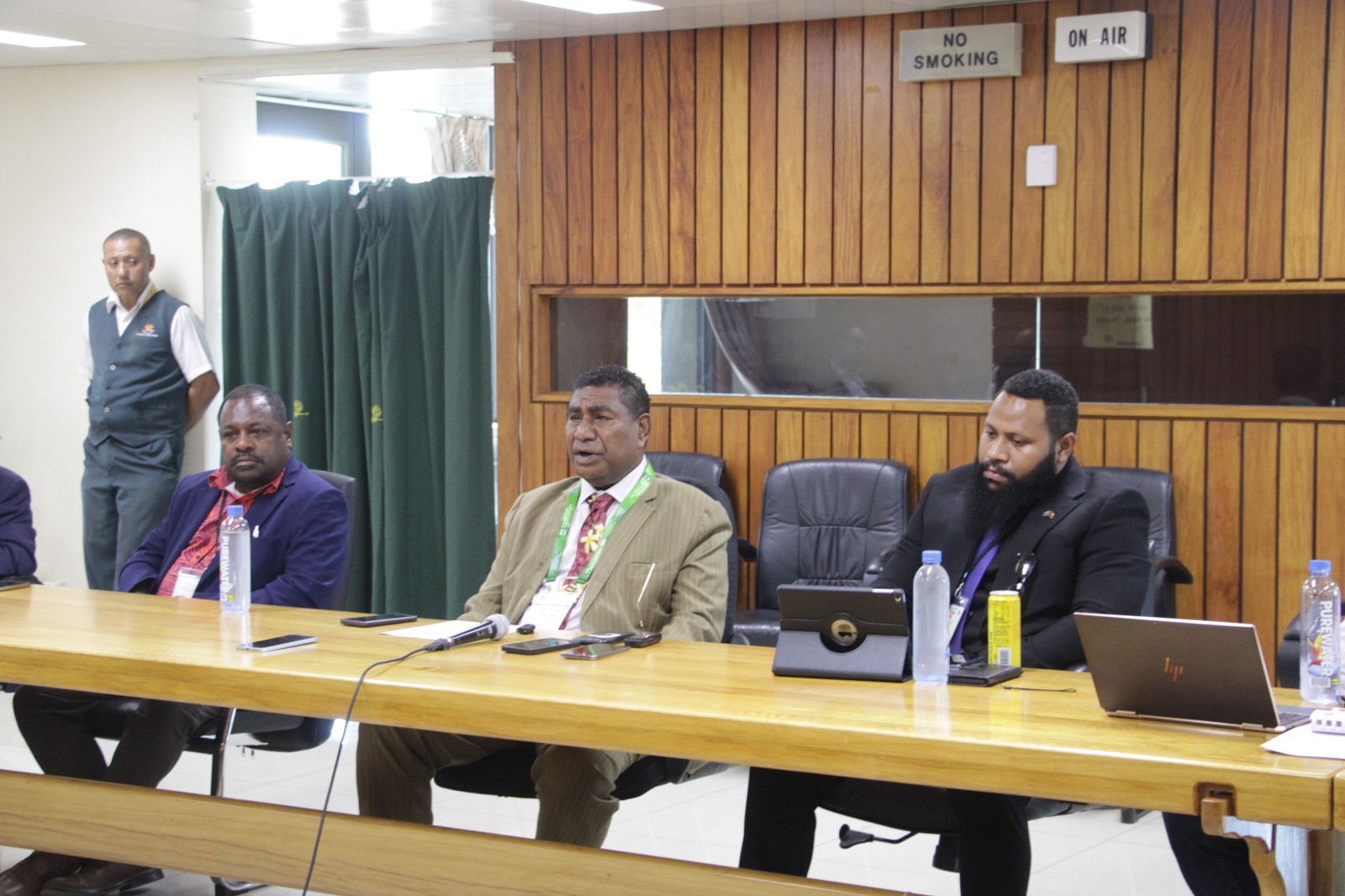
Kairuku leaders and affected landowners in the Central province have rejected the proposed benefit-sharing mode of 5% for the Papua LNG Project, calling for a review of the allocation formula and greater recognition of communities they say will be directly impacted by the project.
Kairuku Rural Local Level Government (LLG) President Terence Rau said leaders had united to ensure the district's interests were protected during the ongoing Papua LNG Development Forum process.
Rau said Kairuku leaders had received the Director's proposal and were reviewing the document while preparing technical responses and submissions.
Rau also thanked the Marape-Rosso Government for retaining Isoaimo as Minister for Energy, saying Kairuku was fortunate to have its elected representative in a key position during the negotiations.
"As the President for Kairuku LLG, the impacted LLG in concern to this Papua LNG forum, it is with great concern and disappointment," Rau said.
He said Kairuku leaders were determined to prevent what they described as a repeat of past experiences under the PNG LNG Project, where they believe the district was not adequately recognised in benefit-sharing arrangements.
"History must not repeat itself. A mistake happened once, and it will not happen again," Rau said.
He assured communities from Yule Island, Naubua Paka, Delena, Poukama, Maori, Oroi and Tautu that their concerns were being represented during negotiations.
"Not being in this room today does not mean you are not heard. Through our honourable member, we stand committed to represent you," he said.
Minister for Energy and Kairuku MP Peter Isoaimo said the press conference was held to present a united position on behalf of Kairuku's offshore pipeline landowners.
Isoaimo said he was speaking not only as a government minister but also as a "proud son of Kairuku" and the mandated leader of the district.
He said Kairuku leaders were formally objecting to the current benefit-sharing allocation model proposed under the Papua LNG Project, claiming it failed to recognise the district's infrastructure footprint and potential impacts on local communities.
"Our people are crying foul over what can only be described as an administrative failure and a structural marginalisation of Kairuku's rightful heritage," Isoaimo said.
He claimed Kairuku landowners were excluded from benefits associated with earlier stages of the Papua LNG Project and warned that the same situation should not continue.
According to Isoaimo, the proposed midstream benefit allocation gives the central Kairuku pipeline segment only 5% of the benefit share, despite the district hosting a significant section of the offshore gas pipeline route.
He argued that the allocation did not reflect the physical location of the infrastructure or the environmental and social impacts on Kairuku communities.
"The mathematics behind this allocation completely falls apart. It defies logic and equity," he said.
Isoaimo compared the proposed allocations across pipeline segments, claiming that some areas with less direct impact received larger shares than Kairuku's central segment.
He said Kairuku communities, including those around Oroi, Nabua, Ala'ala and Yule Island, faced potential impacts due to the pipeline's proximity to traditional marine areas and fishing grounds.
Isoaimo also raised concerns about the Social Mapping and Landowner Identification (SLI) process, calling for the inclusion of communities he said had been overlooked.
He specifically called for Nabua Village, parts of Yare Village in Ward 9, Kairuku LLG, and Yule Island Ward 12 to be recognised as project beneficiaries.
He said climate change and coastal erosion should also be considered when determining project impact areas.
"If these communities had not experienced coastal erosion, they would clearly fall within the 5kilometre economic buffer zone," Isoaimo said.
The Kairuku leadership issued five key demands to the National Petroleum Authority (NPA) and project stakeholders:
A full explanation of the technical calculations and data used to determine the benefit-sharing percentages.
Suspension of the current 5% allocation for Kairuku pending review, recognition of additional communities identified as affected beneficiaries, an independent boundary survey to clarify district and project boundaries and a dedicated negotiation forum between Kairuku leaders, traditional landowners and project authorities.
Isoaimo said Kairuku supported national development but would not accept development that ignored communities directly affected by resource projects.
"We fully support national development and economic progress, but we refuse to let national progress be built upon the marginalisation of the people of Kairuku," he said.
Meanwhile, Kairuku landowner representative Marlen Brunskill supported the concerns raised by Isoaimo and district leaders, saying landowners wanted greater transparency in the process.
Brunskill acknowledged the efforts of the National Government and the National Petroleum Authority in advancing the Papua LNG Project but questioned the consultation process and the short timeframe given to respond to the proposal.
He said landowners had been given only seven days to review documents despite what he described as years of preparation by government agencies.
"The clan vetting has been substandard. There has been no formal survey done by the NPA or the Government on defining boundaries," Brunskill said.
He also raised concerns about environmental assessments, saying landowners had not been provided with sufficient information on environmental impacts or standards.
"There is no science behind where the percentages are created," he said.
Brunskill said landowners wanted proper surveys, clan verification and clear explanations of how benefit percentages were calculated.
"If everyone understands the science, we all understand, it makes the whole process easier. But they have just plucked numbers out of the air," he said.
He said Kairuku landowners supported the Minister's position and remained concerned as custodians of the seabed and marine environment affected by the project.
The Kairuku leadership said it would continue seeking dialogue with the NPA and project authorities while pursuing a revised benefit-sharing arrangement before agreeing to the final Development Agreement.