
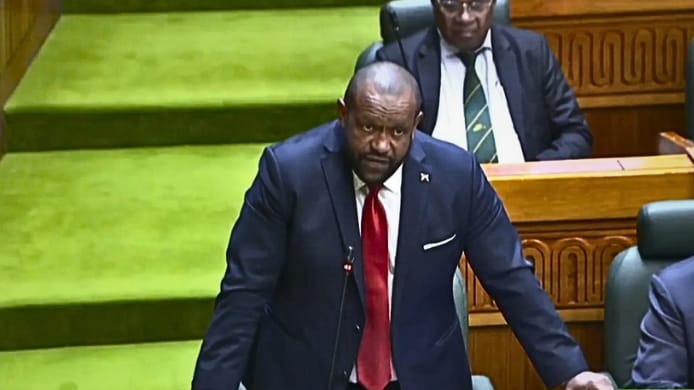
Government accountability came under scrutiny in Parliament yesterday after Opposition Leader and Chuave MP James Nomane questioned the delay in the release of the 2025 Financial Budget Outcome (FBO), a key report that outlines how public funds have been spent and allows Parliament to scrutinise the Government's financial performance.
Raising the matter during the second day of the Third Sitting of Parliament on Wednesday, July 15, Mr. Nomane said the report should have been presented by March 31 in accordance with the Fiscal Responsibility Act 2006 but had still not been tabled four months later.
The Financial Budget Outcome is an annual report that compares the Government's approved budget with its actual revenue, expenditure and fiscal performance, providing Parliament and the public with an opportunity to assess how public funds have been managed.
Questioning Treasury Minister Ian Ling-Stuckey, Mr. Nomane asked why the report had not been presented to Parliament.
"Where is the 2025 Financial Budget Outcome that clearly outlines to the people of Papua New Guinea how the Executive Government has spent the people's money? When is it going to be published?"
Mr. Nomane said Parliament was already approaching August and called on the Treasurer to explain when Members of Parliament would have the opportunity to debate the report.
"We want the Treasurer to explain to the House when we could expect him to bring the report to the floor for debate, discussion and deliberation."
Responding to the question, Treasurer Ian Ling-Stuckey acknowledged the concern raised by the Opposition but did not explain the reason for the delay.
"I thank the Opposition Leader for his prudent question."
Mr. Ling-Stuckey told Parliament the Financial Budget Outcome is expected to be tabled during the next sitting of Parliament, scheduled for August or September.
"The FBO will be tabled at the next Parliament session in August or September this year."
The Financial Budget Outcome is one of the Government's key fiscal accountability reports and plays an important role in ensuring transparency over the management of public finances by allowing Parliament to examine whether government spending aligns with the approved national budget.