

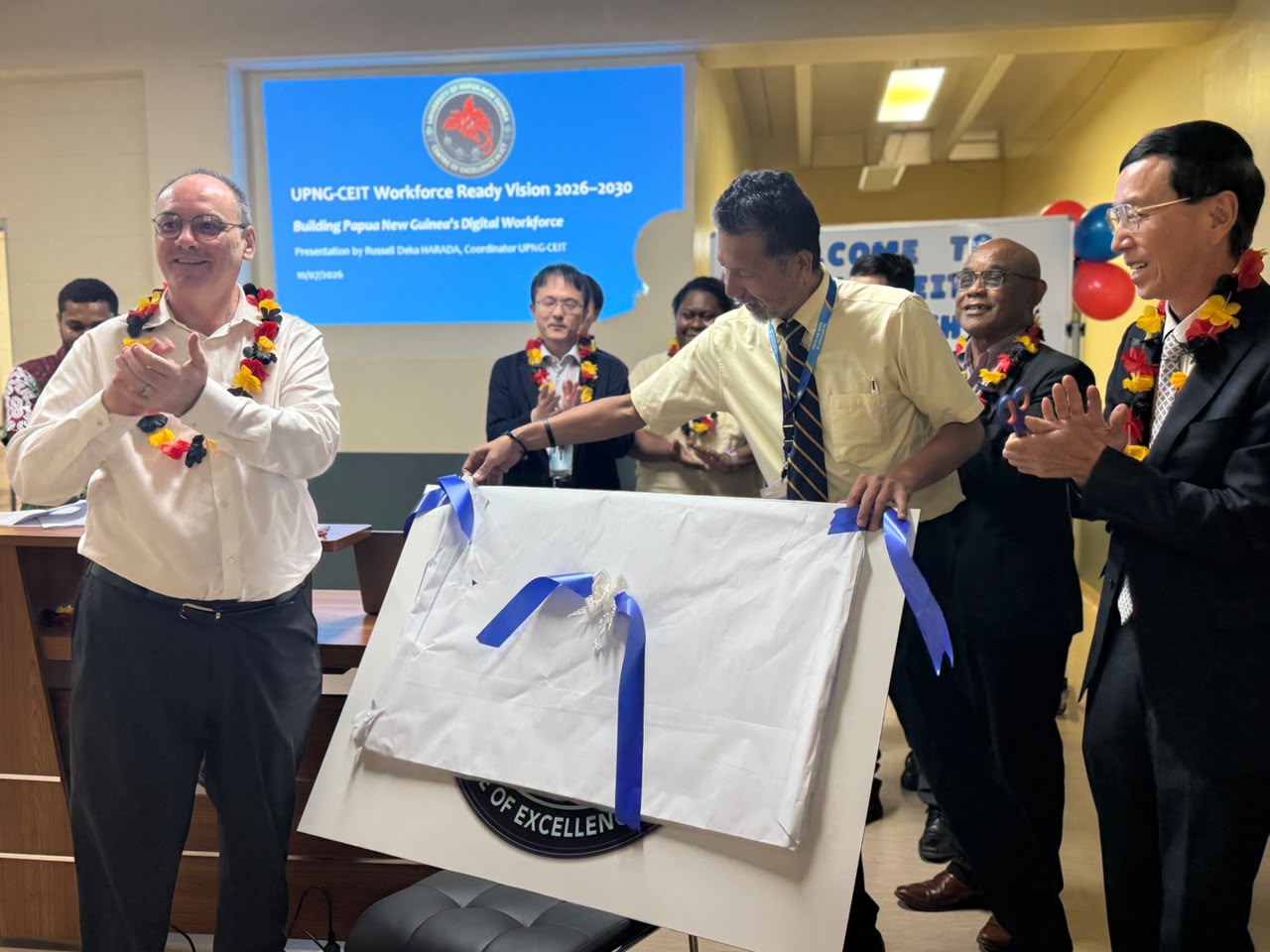
The University of Papua New Guinea (UPNG) has relaunched its Centre of Excellence in Information Technology, marking a significant step in its efforts to equip Papua New Guinea with the digital skills needed to compete in a rapidly evolving global economy.
The relaunch coincided with the launch of three new Information Technology certificate programmes, with the university also announcing plans to introduce specialised IT degree programmes from 2027.
UPNG Vice-Chancellor Professor Ian Findlay said the university was taking a leading role in addressing Papua New Guinea's shortage of information technology professionals.
"UPNG recognises that Papua New Guinea has a major deficiency in IT and in creating IT professionals, and we want to change that," Professor Findlay said.
He said the Centre of Excellence would become a hub for industry-focused education, delivering a range of certificate and diploma programmes designed to prepare students for careers in the digital economy.
"The three certificate programmes we are launching today are just the beginning," he said. "We expect to introduce many more certificates and diploma programmes in the years ahead."
Professor Findlay also announced that the university would expand its academic offerings in 2027 with four specialised bachelor's degree programmes in programming, networking, artificial intelligence (AI) and cybersecurity.
He said artificial intelligence was transforming every aspect of society and that universities had a responsibility to ensure graduates understood how to use the technology effectively.
"We all talk about artificial intelligence, but do we really understand what it is?" he said.
"If we don't understand AI, AI will become our master, and we will be the tools. We have to make sure that we are the master and AI is our tool."
Beyond the new IT programmes, Professor Findlay outlined a broader curriculum review that will embed technology, artificial intelligence, research and critical thinking, and soft skills across every programme offered by the university.
He said graduates needed more than academic knowledge to succeed in today's workplace.
"Your degree will get you the job, but your soft skills will get you the promotion," he said.
Professor Findlay also stressed the importance of developing critical thinking skills in an age where misinformation and disinformation are increasingly common.
"We have access to more information than ever before, but we must learn how to evaluate that information and make informed decisions," he said.
To strengthen student preparedness, UPNG will introduce a university pathway programme in 2027 to help Year 12 students transition into tertiary education, particularly in mathematics and science, subjects Professor Findlay described as essential for success in a digital economy.
The university will also launch a postgraduate diploma in education with a focus on STEM, information technology and digital technologies to better prepare teachers to deliver technology-based education in schools.
"How do we expect students to understand technology if the teachers don't?" Professor Findlay said.
"We have to make sure that our teachers understand technology and IT so they can prepare the next generation."
Professor Findlay said UPNG's latest initiatives reflected the institution's responsibility as Papua New Guinea's premier university and its role in supporting the country's development.
"UPNG doesn't just represent Port Moresby or Papua New Guinea—it also represents the Pacific region," he said.
"As the largest country in the Pacific, PNG has to take the lead, and UPNG has to take the lead for PNG."
He said embracing information technology and artificial intelligence was no longer optional if Papua New Guinea hoped to remain competitive.
"This is the beginning of a new era of IT and technology, not just for UPNG but for Papua New Guinea and the wider Pacific," Professor Findlay said.