
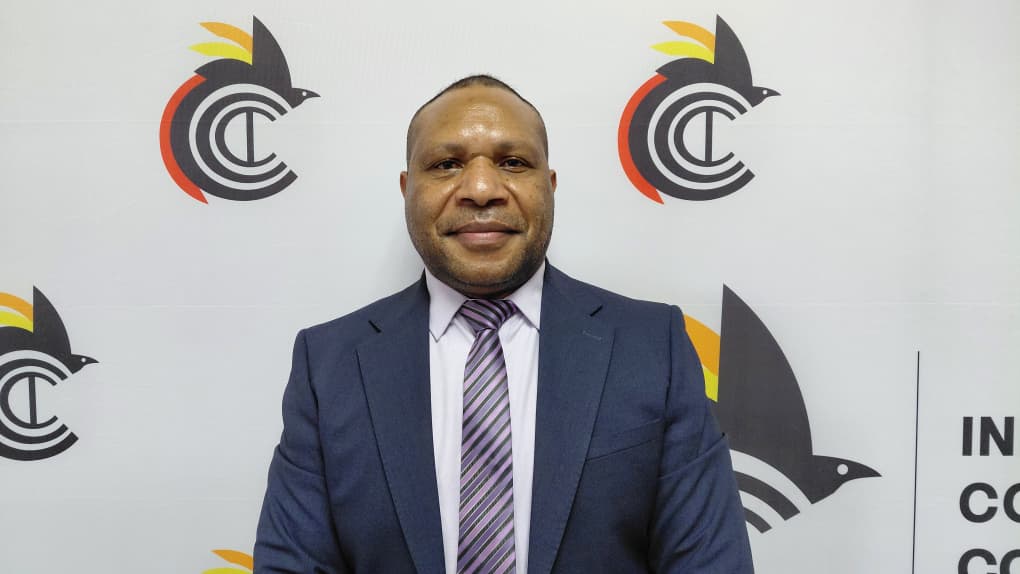
Independent Consumer and Competition Commission (ICCC) Commissioner and Chief Executive Officer (CEO) Mr. Roy Daggy said prosecution would strengthen the commission’s work however, current legislation limits its mandate and powers as a regulator.
Therefore, under the ICCC’s new five-year Corporate Plan, the commission aims to expand its regulatory powers through the proposed Competition and Consumer Protection Bill.
“As a regulator, we never complete the process. The process we need to make sure those non-compliant cases are prosecuted, but now we currently have our additional bill, Competition and Consumer Protection Bill, which will go into Parliament hopefully by November,” Mr. Daggy said.
“If we have this new bill in, we will have more powers, and that can take us down to the road of prosecution.”
Mr. Daggy announced that the ICCC will begin public consultation on the proposed bill on September 7, describing it as an important part of the legislative process.
He said his target is to have at least five non-compliance cases prosecuted in court annually, with decisions handed down.
“For me, being around, I will make sure annually we prosecute at least five cases that go to the court, and we get the decision.”
Successful prosecutions would help deter businesses from continuing to breach regulatory requirements.
“A lot of people, when we want them, they know, but there is no penalty.”
He said some businesses currently pay relatively small penalties and walk away without facing the full prosecution process.
“They just pay a penalty which is less, say. They walk away,” Daggy said.
In addition, ICCC has amended the Price Regulation Act, setting penalties of up to K10,000 for primary offences and up to K30,000 for repeated non-compliance.
“The power is there. Now the next step is to take them to the court to make sure they are prosecuted.”
The commission plans to strengthen monitoring of unfair trading activities and develop stronger competition law expertise.
Mr. Daggy highlighted that activities such as cartel behaviour and bid rigging need greater scrutiny, particularly in public procurement.
“A lot of things are happening without being properly monitored or noticed.”
Moreover, the ICCC has partnered with the National Procurement Commission through a memorandum of understanding (MOU) to monitor and identify possible bid rigging in public procurement.
This partnership will allow the two agencies to monitor public bidding for contracts processed through the NPC.
The ICCC will also look at dominant businesses that abuse their market power to crowd out smaller players.
The proposed legislation is part of the ICCC’s wider plan to strengthen consumer protection and ensure markets operate fairly and competitively.
Mr. Daggy emphasized that the commission’s enforcement decisions would be based on evidence, research, and data rather than pressure.
“It will act with its independent power, honesty and fairness, and making sure decisions are based on evidence, not on pressure or coercion,” he concluded.